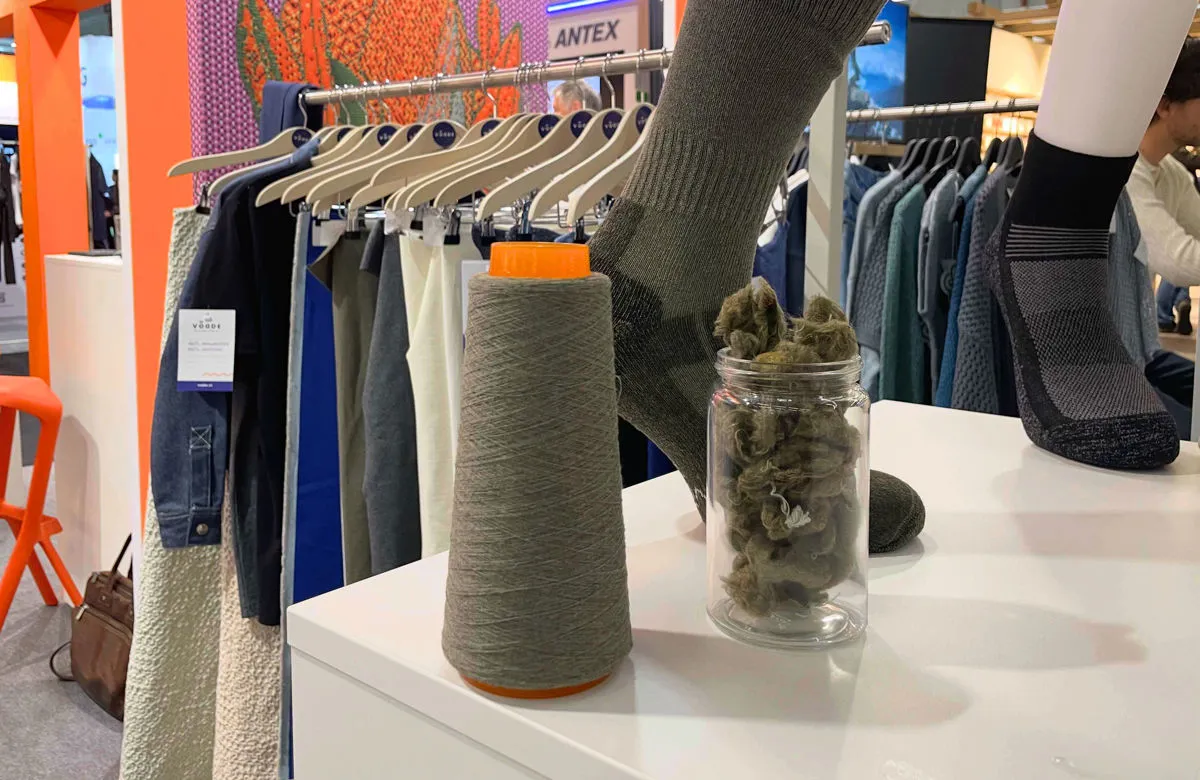
Vodde showcases industrial scale T2T yarns
Textile-to-textile recycler Vodde exhibited at the Dutch digital and circular technologies space at Techtextil this week, presenting its industrial-scale yarns made from post-consumer textiles. The company was founded in 2020 by industry veteran Patrick Welp who has set up a network of companies that can turn fibres made from post-consumer waste into high quality yarns.
The feedstock comes from various sources such as the Salvation Army, the Boer Group, a Dutch collector-sorter, and Vodde has secured a contract with the Dutch government to process its textile waste. These are mechanical recycled, or ‘fiberised’, into spinnable fibres with a capacity to process 15,000 tonnes annually. Of these, Vodde can produce some 450 tonnes of yarns yearly that are spun by four partner mills located in Bangladesh, Turkey and Portugal. In its own facility, the company uses the recycled yarns to make socks, an end-case scenario that works, said Mr Welp, “we know that our yarn is production proof”. For other applications, the yarns are made in various specifications suited to apparel, denim, knitwear, or even technical textiles and sold to fabric or garment manufacturers.
All Vodde yarns are made from 100% recycled content. They have at least 50% post-consumer recycled fibres, mixed with various other fibres including post-industrial recycled fibres, lyocell, or bottle flake recycled polyester. The waste is sorted by colour, which allows the company to offer its yarns in a wide array of shades and therefore do not need to be dyed. This is central to Vodde’s mission to offer products that have a very very light environmental footprint, said Mr Welp.
Though Mr Welp focuses on post-consumer waste, he says that post-industrial waste is needed to optimise production and quality, an essential market demand. “We have developed standard yarns for industry basics such as single jersey (150 gsm) that we know we fully control,” he told Inside Denim.
A few years ago, Vodde supplied its recycled yarns to Inditex-owned brand Stradivarius. The denim products were made from 50% post-consumer waste and 50% lyocell.