Oritain: Switching suppliers has exposed brands to prohibited cotton

21/05/2026
Oritain: Switching suppliers has exposed brands to prohibited cotton

Origin verification provider Oritain has claimed there is a widening "verification gap" between supply chain documentation and reality, as the results of a five-year study show that switching suppliers could have unwittingly exposed brands to ‘prohibited cotton’.

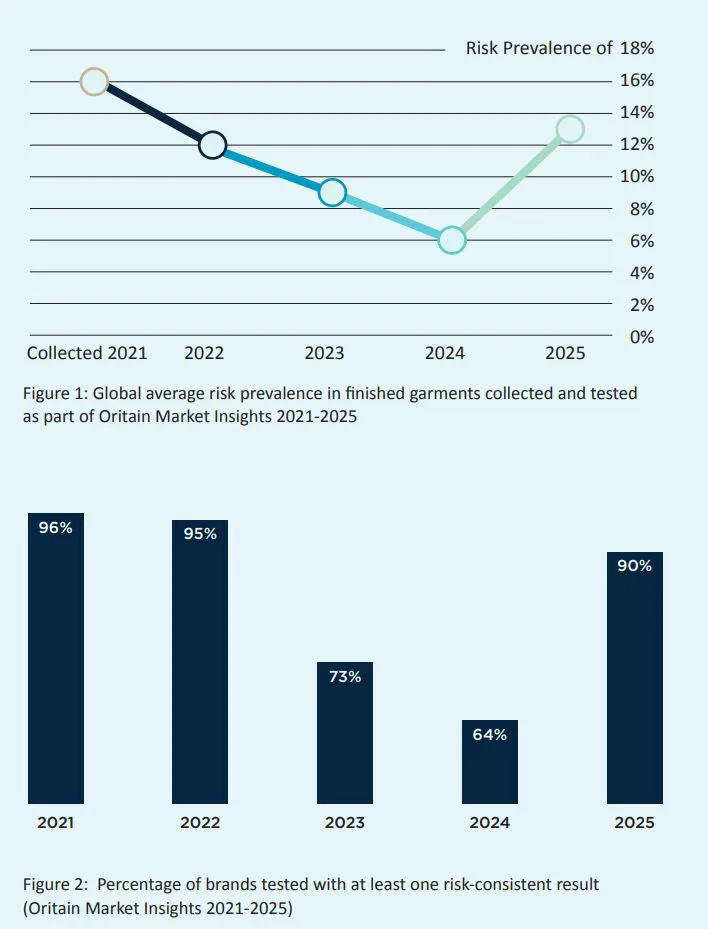
The data shows that after three years of steady progress, exposure to prohibited cotton has fallen back to pre-2021 levels.

While nearly 94% of UK and 87% of US companies tracked now trace their cotton supply chains, Oritain found that 90% of brands analysed in 2025 recorded at least one prohibited cotton result, up from 64% in 2024.

Tariff-driven sourcing shifts are redistributing manufacturing capacity across regions. Since China produces most of its cotton in Xinjiang, brands relocating to Vietnam, Bangladesh and Cambodia still face exposure, said Oritain. This could be because favourable tariff status has driven demand into certain manufacturing hubs faster than capacity can absorb, so factories hire subcontractors to source yarn, cotton and other inputs from the open market. 

Alyn Franklin, CEO at Oritain, said: "As brands pivot manufacturing regions, upstream material exposure hasn't disappeared, it's appearing in new manufacturing hubs. Without independent verification, risk travels quietly through complex trade routes and only surfaces when goods are stopped and costs escalate."

Oritain’s first Global Supply Chain Intelligence Report analysed around 1,000 garments across 40 brands annually between 2021 and 2025. “The programme included well-known brands, many of which are making concerted efforts to source sustainable and ethical cotton for their product by working with their suppliers,” said Anjali Gupta, head of data science at Oritain.

Jason Thompson, vice-president of brand development at US cotton brand Supima, agreed that once a bale of cotton gets past the mill door, brands become vulnerable to substitution. “For decades, the industry has been trying to identify what happens to the cotton after it enters the mill. Only in the last five to seven years has verification technology, like Oritain’s, allowed us to scientifically substantiate our fibre claims.”

New Zealand-based Oritain’s technology uses isotopes and trace elements combined with statistical modelling to verify the provenance of products across fashion and cotton, leather, timber, coffee, meat and dairy.