




Is there life on planet wool denim?
In our common memory, denim is and has always been a blue fabric made of cotton. Yet history shows that before being blue and cotton, denim was something quite different. Tilmann Wröbel says recent shifts in trends seem to confirm that this forgotten chapter of denim history could hold the key to longer-lasting fashions.
Let’s go back to the Middle Ages, the mid-1100s exactly, in Genoa. This was when the city and port of Gênes was a leading financial and trading centre in Europe. The maritime republic was independent, though under various forms of French protection across time. Also, under the influence of religious movements across Europe, it attracted the ‘not purely catholic’, making it something of a cultural ‘big apple’.
More to my point, the maritime city was also where a mix of Mediterranean and work cultures gave birth to a fabric known as fustian of Genova, a heavy cloth woven from various fibres. These, at the time, were mostly wool and linen. Another fun fact? The fabric was brown. What? In those days, heavy tariffs (sound familiar?) on indigo pigments imported from Asia made it impossible to manufacture a blue utility fabric in Europe at a reasonable price. I love it when situations in the past echo what is heard at denim fairs in 2026.
We thus have an early workwear fabric, made in the mid-1100s in Gênes – the city’s French name, stamped on bales that became “jeans” when shipped to Britain – made of wool and at times linen, dyed a beautiful deep brown.
Some experts say that this is the difference between jeans and denim. For, like the people in and around Gênes, those in and around the city of Nîmes made a utility fabric from wool and linen, which at some point, though long before the often-cited 1700s, was woven with 100% cotton indigo-dyed yarns. You could say that the manufacturers in the area of Nîmes, by paying the price for cotton, and the tariffs for indigo, created a ‘posh’ version of jeans.
To sum up, jeans historically was a brown duck canvas made from wool or linen. Denim fabrics were indigo, 100% cotton, and twill. Or this is how textile historians usually see and report it.
Back to the future
Fast forward to today. Linen and wool are making a comeback in contemporary premium denim fabrics. It is, admittedly, a challenge for mills to manufacture a price-competitive fabric made fully out of these, or even in blends. The presence of these fibres signals a superior, premium denim category. They do infuse a sophisticated hand feel, a different, more sartorial drape to our beloved blue fabric.
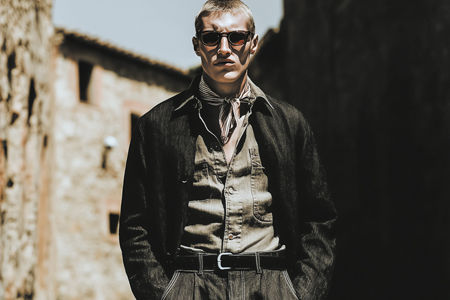
Recent evolutions in design, in the construction of garments, how female, male and gender-fluid outfits are shown on catwalks, indicate a major, long-term shift to more sartorial styles. Not sartorial as in stiff and rigid as it can sometimes be, not old money, nor proper power-dressing. A smart reinterpretation of sartorial codes through a mix of construction and deconstruction. Extra wide ties, tie clips, double-breasted wide slouchy suit jackets are paired with oversized jeans. Sleek suiting fabrics align with rugged, used and patched denim pants. A trend now widely referred to as Smartorial.
Silhouettes from the latest collection of LVMH prize-winner Soshi Otsuki, who worked with Japanese denim brand Proleta Re Art, may best embody this fashion core. Looks combining sartorial denim with a clean shirt and oversized tie express this duality.
Many examples could be cited, but the question I ask myself is how the industry will react to an opportunity to use premium denim as a stepping stone to capture the Smartorial trend.
Candiani recently created a line of wool denims, and followed this with linen denim fabrics. Simon Guiliani’s vision matches mine: “The Candiani denim linen collection, Riviera, embodies a philosophy: a bridge between the origins of workwear when denim fabrics were made from hemp, linen and wool – long before cotton became dominant – and refined tailoring, which has always intelligently paired fibres to seasons.”
Sharabati’s certified Egyptian cotton denim range, which gives birth to a softer and more elegant version of denim, is another example that marketing manager Dilek Erik showed me. Paolo Gnutti, the mastermind behind the Isko Luxury by PG fabric range, says that “the most important is to create a balance between structured tailoring and modernity”. He says that he favours “compact fabrics in select combinations of natural fibres such as cotton, silk, wool or cashmere, with textures designed for elegant drape and everyday wearability”.
Daily Blue’s latest capsule collection, Perfume of the Highlands, features a wool denim fabric made with Pioneer Denim, of China. The wool-blend fabric was difficult to develop, says Adriano Goldschmied. “Early trials made from a cotton weft and a wool filling, were not interesting. We switched to an intimate blend of cotton and merino wool inspired by traditional British Viyella shirting, which gives the fabric the feel of wool.”
Mills have spotted the opportunity and are ready. Let’s hope the brands, designers, buyers and retailers will be ready, too. Amidst the current tumult of industrial challenges, tariffs, war, inflation and changing consumer behaviours, it is comforting to see our denim industry rise to the challenge, hold the flag of innovation, of trend relevance, and develop the premium fabrics that are the original DNA of jeans. This means there is new life on planet wool denim!
Candiani’s linen denims cue the workwear past of jeans, but are presented in a very Smartorial way. Photo: Candiani


