








A chain under strain
The denim industry in Turkey faces multiple challenges from falls in demand and increases in cost. Its vertically integrated value chain is coming under intense pressure.
A year ago, when the president of the US, Donald Trump, launched a far-reaching programme of punitive tariffs on trading partners around the world, he said one of the objectives was for the US to “supercharge our domestic industrial base”. He insisted that more production at home would mean stronger competition and lower prices for consumers. He added: “For decades, our country has been looted by nations, near and far. Foreign leaders have stolen our jobs. Foreign cheaters have ransacked our factories, and scavengers have torn apart our once-beautiful American dream.” He has a particular way of expressing himself; everyone ought to be used to it by now.
To have factories and jobs at hand is what we now call vertical integration. There is an irony here because a number of the few remaining countries that have this vertical integration are watching it erode in the mid-2020s; President Trump’s tariffs are proving to be a catalyst of this erosion, if not a cause. In denim, one of the places where this vertical integration exists is Turkey, but the end-to-end denim value chain there is coming under intense pressure.
Home advantage
Speaking at the Spring 2026 edition of Intertextile Shanghai, specialists at the Istanbul Textile and Apparel Exporters Association point to a fall in demand for products from Turkey in the European Union (EU). This is forcing manufacturers in Turkey to search for ways of saving costs. They say there are two main reasons why the EU, the industry’s biggest customer, has become a difficult market for Turkish mills and garment manufacturers. Probably the more obvious of the two is that there is shrinking demand in the EU because there is economic fragility and a lack of consumer confidence there. The second reason is that, with Chinese producers losing market share in the US following the tariff turmoil that began in 2025, competitors there, who have a price advantage over most Turkish companies, are now “focusing elsewhere”, especially on the EU.
General manager of denim mill DNM, Gökhan Ünsal, insists that Turkey still has advantages and that vertical integration is one of them. He confirms that the set-up covers the whole denim value chain. It has extensive cotton farming, ginning and spinning operations, mills, dyehouses, finished garment producers and laundries all on home soil. “The whole chain should work together, like a good watch,” Mr Ünsal says. “We also have a reliable energy supply, which is an advantage over some competitor countries, including Bangladesh. There, cuts to the electricity supply frequently interrupt shifts in factories.”
He makes the point that, although labour costs are higher in Turkey than in many competitor countries, productivity is higher too. He accepts that the attraction of lower costs is powerful. DNM has had a factory in Egypt since 2011. Taking everything into account, he calculates labour costs in Egypt at between $150 and $200 per person per month, compared to $1,200 or $1,500 in Turkey. Energy is cheaper in Egypt, too, 4 or 5 cents per kilowatt-hour compared to 7 or 8 cents in Turkey.
Flight into Egypt
DNM is far from alone. Recent reports in Turkish media suggest that there could be as many as 200 Turkish textile companies with operations in Egypt at the moment. Another of these is the Sirikcioglu Group, which has a total denim fabric production capacity of 100 million metres per year. Supply chain manager, Tolga Ozkurt, says employment costs in Egypt were at about 10% of the cost in Turkey last year, but may have moved to around 15% now.
“This is still a big difference,” he says. “We are certainly trying to make things work in Egypt, but it is baby steps. The infrastructure is not there yet in terms of water, energy and so on. And keeping employees is a challenge, too. People leave you to try to earn a few dollars more next door.”
Domestic difficulty
Closer to home, Turkey’s vertical integration faces a challenge from changes in its domestic cotton supply. The US Department of Agriculture runs its own Global Agricultural Information Network (GAIN), with people on the ground gathering data on agricultural activity in key countries around the world. A recent report from its team in Ankara projects that cotton production in Turkey for the current market year (August 2025-July 2026) will show important declines compared to previous years.
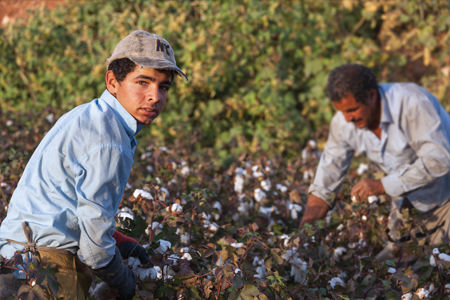
It says the total area across which farmers in Turkey are growing cotton in the current year is 395,000 hectares, a reduction of 15% year on year. The recent GAIN report forecasts production for 2025-2026 of 700,000 tonnes, a fall of 19% compared to the previous year. It says this projection takes into account better-than-expected yields (thanks to favourable weather and new irrigation projects) in south-eastern Anatolia. This region produces at least half of Turkey’s total cotton crop in most years. The report says low cotton prices and increasing production costs have discouraged farmers from planting the fibre more widely.
Anyone’s guess
Of course, Turkey also imports cotton. In terms of consumption of the fibre there in the current market year, the USDA report puts the figure at 1.45 million tonnes, a decrease of 3% year on year. It quotes market sources as saying many yarn producers across Turkey are operating at reduced capacity. For some, this is as low as 50% of full capacity; others have completely ceased production.
It confirms that consumer demand in the EU, including for denim from Turkey, is weak, but it makes a number of additional observations. “The Turkish lira is overvalued compared to major currencies like the US dollar and the euro,” it says. “No increases are expected with regard to orders of Turkish ready-to-wear garments. Some orders will come back if the lira depreciates and the economy stabilises, but when that might happen is anyone’s guess.”
Apart from the EU, the report makes clear, Turkey has consistently been an important supplier to markets across the Middle East, as well as to Ukraine and Russia. War in all of these places has, of course, “contributed to significant decreases in demand”.
DNM’s Gökhan Ünsal thinks that the vertically integrated value chain in Turkey can survive but that the direction for the industry there to go in will be to concentrate on producing high-quality fabrics and garments, and for industry players to work hard to offer faster response times and content themselves with smaller orders.
Farmers in south-eastern Anatolia, the region that produces more than half of Turkey’s cotton crop. Photo: Shutterstock/Yavuz Sariyildiz


