





Patterns vs fades
The making of jeans adorned with ‘deep fake’ digital prints, motifs etched out by lasers or woven into jacquard fabrics, calls for equal measures of technology and craftsmanship. Integrating decors is not necessarily costly and also happens to be one of the most sustainable ways to offer creativity and differentiation.
The uncanny authenticity of high-resolution digitally printed jeans is one of the most graphically striking innovations to come to denim in recent years. It is a potential game-changing solution for mass-market products as the task of creating convincing fades on indigo-dyed denim jeans is reduced to a near one-step process. It has also been widely embraced by premium brands to adorn jeans with faux chains, patches, tears and so on, as it essentially gives designers total creative freedom.
The over-ornamental trend, spearheaded by Swedish label Acne Studios, is the result of advanced digital printers, but designers have also made trompe-l’oeil jeans with everyday equipment. Ukrainian designer Ksenia Schnaider, who produces her jeans in Kiev, used a basic scanner, computer and digital printer to create the optical illusion of jeans pasted on white trousers in her spring 2025 collection.
In most cases, designing these printed jeans begins with a scan of an authentic vintage piece. That is however only part of the story, as anyone who has experimented with the technique – hailed by some as the future of denim – will have found. “It is a mix of artisanry and technology,” says Philippe Mignot, founder of Next Printing. It took the company, which is now a division of Italian accessories maker ACM, six years to achieve the desired effect, brilliantly rendered by Acne Studios. “First, you have to start with a real product, not AI-generated imagery,” he says. The development process then calls on an array of skills: graphic designers, patternmakers, even cutters are involved in finetuning the design. “But once the design is done, it can be reproduced infinitely,” he notes.
Sizing, or grading, is the second critical issue, as faux jeans ‘patterns’ need to be adjusted to each size. This time-consuming process requires skills in both computer-generated imagery (CGI) and patternmaking. Ksenia Schnaider’s double take unsewn jeans may have started with an idea, a pair of jeans and a scanner, but it was followed by extensive work by her partner Anton, a graphic designer. “Making printed jeans is akin to couture,” she says. “It is a true craft, it requires thought. People may think they are a basic pair of jeans, but they are the result of a lot of handwork and fittings.” In her latest collection, she made a matching puffer jacket and skirt from a denim-printed nylon fabric. They were stitched like proper jeans to add a whiff of authenticity to the trompe-l’oeil denim set.
A waterless process
Production of printed jeans is scaling up. At Next Printing’s facility near Bergamo, two 3.5m wide devices print at a rate of 1,000 metres per hour. The near waterless technology bypasses the warp yarn indigo dyeing and eliminates many laundry processes, rinses aside. For Mr Mignot, the technology has high potential in the mass market and as a premium one-off solution. “Our technology makes it possible to create super vintage looks that are no longer possible today with restrictions on chemicals and water usage,” he says. “We are giving designers new tools to create and mix different techniques.”
Federico Barengo, of Garment Workshop, has collaborated with Next Printing to showcase the technology’s possibilities. He chose to rework items from his own archives. “I see them as artefacts that evoke denim’s rich heritage, where every detail has a story to tell,” he says. “The advantage of digital printing is that it consumes only three litres of water per item, instead of 40 to 60 litres of water needed to make and fade jeans conventionally, or the years of wear and tear that give jeans their distinctive character.”
Based in Izmir, Turkey, Sarp Jeans has recently established a denim printing division, Inks & Dots, with a group of partners that include Italian printer maker Reggiani and Danish digital design studio WOPTAG. The design process does not start with a scan, but from a pattern database. A software programme handles grading, and cutting is also automated.
“Printing offers endless design possibilities, but achieving the real look of denim is the most difficult. Crazy ideas are easier,” says Sarp Jeans’ creative director Gizem Batur. “Trompe-l’oeil jeans will not replace real denims, but they are a new and very sustainable way of creating jeans.” Uraz Batur, general manager, notes that adoption is driven more by sustainability and technology than by price.
LAB Denim’s digital print solution uses innovative algae-based dyes that are presented as a step more sustainable. Co-founder Dr Mickael Mheidle has developed a new class of reactive dyes that are said to deliver rich visual depth and more stable performance. The company’s technology also draws on Dr Mheidle’s long-standing work in digital printing, as he was involved in the creation of DReAM, an early digital textile printer, with Reggiani. LAB Denim calls its system digital dyeing, not digital printing. It has installed a printer in its Los Angeles base and is in advanced trials with brands.
CoolTrans, a high-resolution transfer printing solution developed by NTX, can produce strikingly authentic deep fake jeans, front and back, in a single pass. Shein has been working with the Singapore-based company since 2021 and announced that it produced 380,000 faux denim items in 2024, almost double the 200,000 made in 2023. The ultra-fast fashion e-tailer promotes the process’s water and energy savings, as well as its speed to market. Denim mill Stella Blu, a division of China’s Prosperity Group, worked with NTX to develop the denim applications and now markets the technology as WOW (WithOut Water).
Although presented as faster and more reproducible than conventional jeans production, printing does have limitations. One of these is that it imposes single-layer cutting. Another is that the pattern is most often printed on one side only. While it is possible to print a weft motif on the back of the fabric, this doubles the price, says Mr Mignot.
The deepfake jeans have sparked great excitement in denim circles. “We are at the mere tip of the iceberg,” says Adriano Goldschmied who believes digital printing brings much-needed innovation, as well as speed and lower impact. “Reacting quickly to the market is vital. In a matter of days or weeks, I can develop a project,” he tells Inside Denim. Textile innovation consultant Neil Bell is even more enthusiastic: “in five to ten years, the entire business will have shifted to print”.
Lasered logos
Printing is not the only way to create graphic jeans. Brands large and small laser their logos and signature motifs on denims. For Jeanologia’s creative director Carme Santacruz, the technology offers flexibility in design and operations, but it is also a craft. “The laser allows great creative experimentation, but translating ideas into real products is another matter. For that, you need to understand denim conceptually and technically.”
This March, the company is introducing a new design tool, Billy AI. “This generative AI tool can take any garment image and instantly generate a precise laser-ready production file, capturing all the details needed to replicate authentic wear and vintage effects on denim,” explains Ms Santacruz. “It significantly speeds up the design process, reducing what previously required hours of manual work to just minutes.” A demo collection, combining digital printing and lasering, created with the Denim House, will be shown at Kingpins Amsterdam.
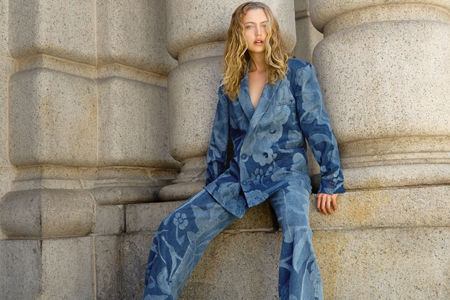
Finnish brand Marimekko is a big fan of laser-etched motifs on jeans. The brand’s first Maridenim line, launched in 2024, featured a lasered version of its iconic Unikko pattern. French designer Marine Serre uses the same technique to mark her upcycled jeans with her signature moon motif. Ksenia Schnaider had graffiti and brick wall patterns lasered on her denim collection a few seasons ago “to evoke an urban setting”.
Just jacquard
While printing and lasering are near waterless processes, jacquard patterns are both a fabric and a pattern, offering creative leeway and low impact. Admittedly a small segment of the denim market, many mills offer them as a graphic option. Kilim Denim, in Turkey, has a wide selection and does not impose minimum quantities. “This allows brands to test more daring patterns. They can produce small runs, test the market, and repeat orders if the reference is successful,” says sales manager Isil Candan. She also notes that jacquard jeans tend to require fewer “fancy washes” and are thus faster to market.
Textile designer Wayne Chiang, who founded 496 Fabric Lab in 2012, is arguably the staunchest supporter of jacquard in jeans as that is the company’s speciality. The mill has invested in advanced, AI-driven looms that enable the company to produce small runs (300m MOQs) and to offer fast lead times.
“My aim is to show that jacquard can move denim beyond utility and become a medium for cultural and artistic expression,” he tells Inside Denim. The collection is now organised in clearly defined categories to help buyers navigate the wealth of patterns the mill creates. “Brands come to 496 Fabric Lab seeking differentiation. A denim fabric that is lasered or printed will not have the same texture,” says the designer.
Fashion and textile designer Kelly Konings creates new jacquard designs for 496 Fabric Lab every season. “We share a same love for weird textures,” she says. “Wayne has a good eye for fashion. He knows what designers want.” Ms Konings also appreciates collaborating with a company experienced in weaving. “For jacquard, you don’t need the best looms, you need the best technicians.”
Last year, she created ten fabric designs for Prato-based denim mill Gommatex, shown at PV Denim in Milan. These made the most of a fil coupé or cut thread technique, which creates layered or three-dimensional effects that emphasise texture more than pattern. “I like to create uneven or organic effects, as if the fabric were hand woven,” she says. “The advantage of jacquard is that it scales. These fabrics may have an artisanal look, but they are fully industrial.”
Any attempt to push denim design beyond its boundaries will be met by the industry’s allegiance to authenticity. “I always respect the twill of denim and often incorporate diagonal lines in my designs,” says Ms Konings. She has also created a faux denim using deadstock yarns in shades of blue in a gradient jacquard pattern. “The resulting fabric looks as if it were dip dyed. From afar it resembles a normal denim fabric, but up close, you can see that it is not.” Printed jeans, even with wildly excessive patterns, tend to emulate denim without straying far from the norm. This is what makes the trompe-l’oeil trend so striking, as there is often much more than meets the eye.
In a capsule collection launched last autumn, Diane von Fürstenberg’s creative director Nathan Jenden included denim lasered with a Dancing Rose motif from the brand’s archives. PHOTO: Diane von Fürstenberg


